As Particle physics experiments take center stage, this opening passage beckons readers into a world crafted with good knowledge, ensuring a reading experience that is both absorbing and distinctly original.
These experiments delve into the fundamental building blocks of matter, exploring the forces that govern their interactions. From historic discoveries dating back to the early 20th century to groundbreaking advancements at major facilities like the Large Hadron Collider, particle physics continues to push the boundaries of our understanding of the universe.
Overview of Particle Physics Experiments
Particle physics experiments investigate the fundamental constituents of matter and the forces that govern their interactions. By using advanced technology and methodologies, scientists aim to understand the building blocks of the universe, from the smallest particles to the complex structures they form. These experiments have shaped our understanding of the universe, providing insights into everything from the origin of mass to the nature of dark matter.The foundation of particle physics research lies in the exploration of fundamental forces: electromagnetic, weak, strong, and gravitational.
Over the years, various experiments have unveiled the existence of subatomic particles, leading to the development of the Standard Model, a theoretical framework that describes how particles interact. Each experiment has contributed to historical milestones that have expanded our knowledge base and technology.
Historical Milestones in Particle Physics Research
The journey of particle physics is marked by significant discoveries and breakthroughs. Each milestone has paved the way for understanding the universe at its most fundamental level. Some key historical events include:
- Discovery of the Electron (1897): J.J. Thomson’s experiments using cathode rays led to the identification of electrons, establishing the existence of subatomic particles.
- Development of Quantum Mechanics (1920s): The formulation of quantum mechanics provided a theoretical framework for understanding the behavior of particles at atomic and subatomic levels.
- Discovery of the Neutron (1932): James Chadwick’s discovery of the neutron expanded the understanding of atomic structure and led to the realization that atomic nuclei are composed of protons and neutrons.
- Invention of the Particle Accelerator (1930s): The development of particle accelerators allowed scientists to collide particles at high energies, opening new avenues for experimental physics.
- Confirmation of the Weak Interaction (1983): The discovery of W and Z bosons at CERN confirmed the electroweak theory, integrating electromagnetic and weak forces into a single framework.
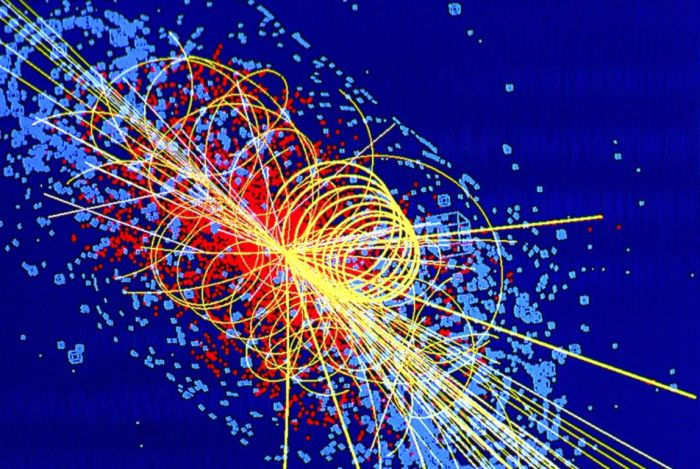
- Higgs Boson Discovery (2012): The identification of the Higgs boson at the Large Hadron Collider validated the mechanism that gives mass to elementary particles.
Significance of Particle Colliders Like the Large Hadron Collider (LHC)
Particle colliders play a crucial role in advancing our understanding of particle physics. The Large Hadron Collider (LHC), the world’s largest and most powerful particle accelerator, enables scientists to conduct high-energy collisions between protons. The significance of the LHC can be observed in several ways:
- High-Energy Collisions: The LHC can achieve collision energies of up to 13 TeV, allowing researchers to recreate conditions similar to those just after the Big Bang.
- Discovery Potential: By smashing protons together, the LHC has the potential to uncover new particles, including those predicted by theories beyond the Standard Model, such as supersymmetry.
- Precision Measurements: The LHC facilitates precise measurements of known particles, refining the understanding of their properties and interactions, which is vital for validating theoretical predictions.
- Cross-Disciplinary Collaboration: The LHC fosters collaboration among physicists, engineers, and computer scientists from around the globe, promoting innovation and knowledge sharing across disciplines.
The LHC is a testament to human ingenuity, pushing the boundaries of our understanding of the universe’s fundamental laws.
Methodologies in Conducting Experiments

The methodologies employed in particle physics experiments are crucial for understanding the fundamental components of matter. These methodologies encompass a variety of experimental setups, data collection techniques, and analysis methods that ensure reliable findings and interpretations. The precision and accuracy of these experiments hinge on the careful design and execution of each element involved.
Experimental Setups in Particle Physics
Particle physics experiments often utilize several sophisticated setups to investigate subatomic particles. These setups are designed to create conditions that mimic the extreme environments found in cosmic events or during high-energy collisions.
- Particle Accelerators: Machines like the Large Hadron Collider (LHC) accelerate particles to near-light speeds, facilitating collisions that generate other particles for study. The energy levels achieved allow scientists to probe deeper into the structure of matter.
- Detectors: Various detectors, such as bubble chambers, wire chambers, and calorimeters, capture and analyze particles produced in collisions. Each detector type is tailored to identify specific properties of particles, like charge, mass, and energy.
- Neutrino Observatories: Facilities like Super-Kamiokande employ massive volumes of water or ice to detect elusive neutrinos, providing insights into their properties and the processes generated in supernovae or nuclear reactions.
Data Collection and Analysis Techniques
Data collection in particle physics requires meticulous methods to ensure high-quality data for analysis. Advanced technology and techniques are essential for interpreting the outcomes of experiments.
- Trigger Systems: These systems are designed to quickly identify interesting events among the vast amount of collision data. They filter through events in real time, allowing only those meeting predefined criteria to be recorded for further analysis.
- Data Logging: Once events are selected by trigger systems, they are logged into large-scale databases. This data includes detailed information about the particles involved, their energies, and decay paths.
- Statistical Analysis: Advanced statistical methods, such as Bayesian analysis and machine learning techniques, are employed to interpret the collected data, identify patterns, and extract meaningful conclusions from the experiments.
Detection Methods for Subatomic Particles
The detection of subatomic particles is a critical aspect of particle physics, with various methods employed depending on the type and properties of the particles being studied. Each detection method has its own advantages and applications in research.
| Detection Method | Advantages | Applications |
|---|---|---|
| Scintillation Detectors | High sensitivity and fast response time. | Used for detecting charged particles and gamma rays. |
| Geiger-Müller Tubes | Simple design and low cost, effective for beta and gamma radiation. | Commonly used in radiation safety and monitoring. |
| Silicon Detectors | Excellent spatial resolution and energy measurement capability. | Widely used in collider experiments for tracking particle trajectories. |
| Time Projection Chambers | Allows for three-dimensional reconstruction of particle paths. | Useful in high-energy physics experiments to study complex events. |
The choice of detection method is often dictated by the specific goals of the experiment and the nature of the particles being studied. Each methodology provides unique insights into the fundamental aspects of particle physics, contributing to our understanding of the universe.
Interdisciplinary Connections and Implications
The field of particle physics not only expands our understanding of the universe but also fosters connections across various disciplines, influencing social, empirical, and natural sciences. This integration highlights the importance of collaborative approaches to problem-solving and knowledge sharing, demonstrating how advances in one area can resonate throughout others.
Impact on Social and Empirical Sciences
The implications of particle physics extend beyond theoretical frameworks into practical applications that affect social and empirical sciences. Discoveries in particle physics have led to the development of technologies that impact everyday life, including medical imaging devices like PET scanners and advancements in radiation therapy for cancer treatment. The conceptual foundations of particle physics also challenge traditional views in philosophy and sociology, prompting discussions about the nature of reality and the interconnectedness of all scientific disciplines.
Influence on Natural and Physical Sciences
Findings in particle physics often serve as a catalyst for innovation in natural and physical sciences. For example, the principles derived from particle interactions are pivotal in understanding chemical reactions at a fundamental level. Particle detectors, initially designed for high-energy experiments, have been adapted for environmental monitoring, allowing scientists to track pollutants and study climate change more effectively. This cross-pollination of ideas illustrates the significance of particle physics in enhancing our comprehension of the natural world.
Relevance of Computer Science Education
Analyzing data from particle physics experiments requires a strong foundation in computer science. The vast volumes of data generated by particle accelerators necessitate sophisticated algorithms and computational techniques for data analysis, necessitating the inclusion of computer science education in the training of physicists. Knowledge in programming languages, data structures, and machine learning models empowers researchers to extract meaningful insights from complex datasets.
Furthermore, collaborative projects in data analysis encourage interdisciplinary teamwork, combining physics, computer science, and statistics.
Anomalies in Particle Physics
Anomalies observed in particle physics can challenge existing theoretical frameworks and open avenues for alternative scientific perspectives. For instance, discrepancies in measurements related to the muon g-2 value suggest potential new physics beyond the Standard Model, indicating the possibility of undiscovered particles or forces. Such anomalies not only stimulate further research but also encourage scientists to reconsider established theories and explore innovative ideas that may redefine our understanding of the universe.
Framework for Education and Training
To cultivate the next generation of researchers in particle physics, a structured educational framework is essential. This framework should encompass the following components:
- Theoretical Foundations: A strong emphasis on quantum mechanics, relativity, and particle interactions.
- Experimental Techniques: Hands-on training in the methodologies used in modern particle physics experiments.
- Data Analysis Skills: Courses designed to build proficiency in data processing, analysis, and interpretation.
- Interdisciplinary Collaboration: Opportunities for students to engage with professionals from various fields, fostering a collaborative spirit.
- Ethics and Philosophy: Discussions on the philosophical implications of scientific discoveries and the ethical considerations in research conduct.
This comprehensive approach will not only enhance knowledge and skills but also promote innovative thinking and interdisciplinary collaboration, ensuring that future generations are well-equipped to tackle complex scientific challenges.
Last Word
In conclusion, the realm of particle physics experiments not only reveals the intricate workings of the universe but also fosters interdisciplinary connections that enhance various scientific fields. As research progresses and new discoveries unfold, the implications of these experiments promise to transform our knowledge and technological capabilities for years to come.
User Queries
What is particle physics?
Particle physics is the branch of physics that studies the nature of particles that constitute matter and radiation.
How do particle colliders work?
Particle colliders accelerate particles to high speeds, allowing them to collide, which helps scientists observe the resulting interactions and discover new particles.
What is the significance of the Higgs boson?
The Higgs boson is crucial because it confirms the existence of the Higgs field, which gives mass to other particles, thus playing a fundamental role in the Standard Model of particle physics.
What are neutrinos, and why are they important?
Neutrinos are nearly massless particles that interact very weakly with matter; studying them can provide insights into fundamental processes in the universe, including nuclear reactions in stars.
How is data analyzed in particle physics experiments?
Data from experiments is analyzed using sophisticated algorithms and software to identify patterns, anomalies, and potential new particles from the vast amounts of information collected.